Showing posts with label Covenanter Rebellions. Show all posts

Sunday, 10 February 2019

Battle of Newburn Ford, 28th August 1640 Pt. 1: 1300

So finally got soldiers on the table. It’s going to be a long process, but going to be well worth doing. Goal: to play every single battle of the English Civil War. Madness-probably. Impossible: Probably. But I think, well worth it for giving purpose towards further writing/modelling projects.

The battle is set out as a mini-campaign around the only major battle of the Bishops War, at Newburn Ford. the battle will be played out over five games, with each game feeding into the other-so that if a unit of two dragoons appears in the first scenario, get killed off, but i due to appear in the 5th scenario, they remain dead, thus sewing a seed of doubt at the back of the commanders mind needing to conserve troops for later use.
Related image
Background
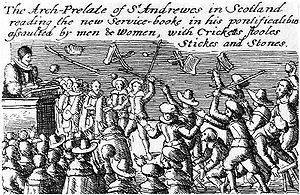
Amid widespread opposition to Charles I’s imposed Episcopalianism and New Book of Common Prayer on a dominant Scots’ Presbyterian Population in 1637, the population of Southern Scotland signed the National League and Covenant and raised an army. Outstripping anything the King could raise, its officer corps blooded in Sweden and the Low Countries, the Scots’ emerged victorious from the short lived First Bishops War, with two ignominious standoffs at Kelso and Duns Law. However Charles was not one to sit idle for long and conflict would continue. To pre-empt Charles, the Covenanters must invade first.
Related image
Reaching the lowest crossing point on the River Tyne, the Covenanter forces under Sir Alexander Leslie could effectively bottle in the coal trade coming out of Newcastle, from the weak southern defences, hampering any Royalist opposition before it could even muster. Outnumbering their Royalist opposition by 7:1, the Covenanters held all the negotiating cards.
Image result for newburn ford battle map
A Royalist detachment from the garrison of Newcastle under Lord Conway, had initially ensconced themselves at the ford. He had been ordered personally by the Earl of Strafford to give battle to the Scots by any means necessary. John Rushworth wrote;

... were drawn forth into a plain Meadow ground which was near a mile in length, close on the South side of [the] Tyne, called Newborne-Haugh or Stella-Haugh, to hinder the Scots from passing the River in the night time, where were two several Sconces or Breast-works raised by the English against the two Fords, which the Scots might pass over at Low water, for till then they could not pass the Tyne, and into each Sconce were put four hundred Musqueteers and four pieces of Ordinance.

The Horse were drawn into Squadrons in the said Haugh at some distance from the Foot, in this posture Horse and Foot guarded the River all that night and the next day, till the engagement.

The Scots all the forenoon watered their Horses at one side of the River, and the English on the other side, without affronting one another or giving any reproachful language.
Image result for sir alexander leslie
Sir Alexander Leslie
Captain Thomas Dymock wrote;

Their army appeared marching on the hills above the ford when we were drawing into our miserable works in the valley, where we lay so exposed to their battery, that their great shot was bowled in amongst our men, to their great loss.

John Rushworth on the Scot’s dispositions;

The Scots, having the advantage of the rising ground above Newbourne, easily discerned the posture and motion of the English Army below in the Valley on the Southside the River, but the posture of the Scots Army the English could not discern, by reason of the Houses, Hedges, and Inclosures in and about Newbourne.  The Scots brought some Cannon into Newbourne Town, and planted some in the Church Steeple a small distance from the River Tyne, their Musqueteers were placed in the Church, Houses, Lanes and Hedges in and about Newbourne.

 At midday on the 28th, Leslie sent forward a herald to give terms, assuring Conway of no ill will on his part, wishing to petition the King. Conway agreed to a small party, but not the whole army. The herald was taunted away by the Royalist pickets.
Newburn from Ryton
Looking from the Scots positions at Ryton, down onto the battlefield

At 1pm, with the tide falling, a Scottish officer, wearing a black feather in his bonnet, rode into the river. He was shot down immediately. This prompted Leslie into an initial advance led by 300 Covenanter horse.
Image result for newburn ford from ryton
How it played out
Played out on a 120cm2 table, victory depended on routing the other army from the field. Caught in an immediate crossfire, options were limited to the four units of Covenanter Dragoons. Note, you will notice many of them depicted in redcoats throughout the article, this was due to the 1640 issue for Monroes Scot’s Army for Ireland being issued with them-they are likely to have worn out very quickly.

However initial initiative failures on the part of Conway’s forces, commanded by yours truly, meant that ample time was provided for the dragoons to find cover within the ample tree line on the far side of the Tyne. But, still being too far away from the Royalist earthworks, no pot-shots could to be taken at their opposing gun teams. Any river crossing will slow down an army’s progress and this would be no different. Call it Cole’s crossing, 17th century style.


However, succeeding on initiative the following turn and successfully rolling to fire, a round shot barrelled into Leven’s unit. Only one casualty was inflicted, but this was crucial when rolling to inflict a lucky blow, it became apparent that Leven had had his head taken off-curtailing any further military reputation at Marston Moor! All subsequent units passed their initiative, but with their commander out for six, stopped for that turn. A further shot barrelled into Leven’s dragoons, taking out another three, but they remained intact.


The following turn, provided a bit of welcome release to the Covenanters, with both guns now reloading, and the Royalist foot trying to invert, to provide covering fire once the dragoons got across the Tyne. However failed initiative from Monck’s company meant this was only partly achieved. However initially this would not matter, advance now being slowed by the dragoons wandering from the woods and venturing into the tide.


This would be most felt as again a raging crossfire, forced all but one unit back across the river, Leven’s own dragoons being wiped out. But rallying, Montrose’s successfully got across and in and amongst the earthworks, delivering a point blank volley at Monck’s company and wiping it out before the guns and infantry could pivot to meet this threat. Applied use of massed volleys and hailshot being used to wipe the Covenanter threat from the field.

Will they have a chance to build a successful bridgehead to finally take out the guns? Find out next month.
Sources:
Guest, K and D. British Battles: The Frontlines of History in Colour Photographs (HarperCollins/EH, 1994)
Leck, M. “Weapon’s for the Rebels: The Swedish Influence on the Battle of Newburn” Wargames, Soldiers and Strategy 87 (Karwansaray Publishing, Zutphen, 2016)
English Heritage Battlefield Report: Newburn Ford 1640 (London, 1995) DOI: https://content.historicengland.org.uk/content/docs/battlefields/newburn.pdf

Sunday, 7 February 2016

Objectives for 2016

So a bit late I know, but thought it would be a useful endeavour to cover what I actually plan to do wargaming wise and timetable projects for this year. Since the New Year a couple more projects have come to the fore, so this is expanding on existing projects.

1. Lion Rampant Army for Earl of Mar-Using Perry Miniatures Plastic HYW miniatures, this will be a lowland Scots late medieval force for the Claymore Rampant wargames day event being held by Claymore Castings. Predicted end of project 22nd March

2. ECW-With the spate of English Civil War rules being released including The Kingdom is Ours, Bicorne Miniatures, Baroque Impetus, The Pikeman's Lament, En Garde and the Pike and Shotte Supplement, a working army for the period is essential. Other projects keep on getting in the way, so a finishing preliminary date pushed back from originally is May 1st. 

3.May Zulu-Forming forces for the The Men Who Would be Kings rules for the Zulu Civil Wars, this has been on the painting books for some time, hopefully being expanded into the Zulu wars/Boer Wars at a later date. 7th October

4. 17th century-Scots government Army for the Pentland/Covenanter Risings/Killing Times. Expected time for finishing, new year.

5. After this occasional work throughout the year will also be put into building a series of earthworks and other terrain features such as 4' walls, a gate and breech, minefields, Rommel's asparagus, vinyards, pontoon bridge, tank traps, marsh, Bulwarks 3’, Damaged sconce, Minehead, Industrial Complex, Winter trees, Winter bushes, ravelin and batteries.

In between, there is a thought towards building a small Border Reiver force. But I think this timetabling is a good way of keeping track of where projects are going.

Saturday, 23 January 2016

Mini Mania Pt.3- 17th Century Pike and Shotte

 Rather than lamenting inability to take part in the Holy Holly Day celebrations commemorating the Battle of Nantwich 1644 today, I feel it is time for another showcase. So as many of you might know, the 17th century and in particular The English Civil Wars are my favourite period of history and certainly the period I wargame the most. I research, am just finishing writing a book on the period, I reenact it, it is the period to which I feel I am an authority on. Therefore do not be surprised if in coming posts there is a predisposition for lots of 17th century material.

A quick note on photo's, still having issues with lighting and exposure-winter in Scotland does not make for the best framing of shots. Certainly for my part, I feel some of the issue is with the image resolution rating,  will from now on be raised to 18megapixels to make the best use of zoom focus and detail. Obviously at the moment this is a try and test method;we all want good looking miniatures, so photography is very much an uphill battle. If any followers want to further show me some free photo editing software available online, would be more than appreciated.


Petard and Petardiers Assistant, 28mm Foundry

2 Scots Frame Guns from Warlord Games.


The start of what I hope to be the next 17th century project after ECW is concluded (for the moment) and Zulu War. Wargaming the Covenanter/Pentland Risings 1666-71. What is so good about the period is that uniforms and units making up the Scots Government army are virtually the same as those at Sedgemoor in 1685, thus killing two birds with one stone, while also adding a couple of Scots Militia/Highlanders to the mix (as seen in the lower of the above). I'm not sure about doing Covenanter/Monmouth rebels for the period, as so few manufacturers make them, with little or no variation in pose. What I might do is go down the root that Wargames, Soldiers and Strategy did for their Glorious Revolution issue (and the Sealed Knot for every Sedgemoor reenactment) and use ECW armies and just buy available rebel figures to mix in. What are your thoughts?  Top Royal Regiment of Dragoons. 28mm North Star 1672


Leslie's Lifeguard, Cuirassiers (possibly previously in Swedish service as Argyle was also listed in one source as having a Cuirassier Lifeguard). 28mm Warlord Games
28mm Bicorne Miniatures Frame Gun. Quite possibly my favourite ECW manufacturer, I think I shall be coming to them for a large amount of my next purchases. Tons of character, paint up beautifully (although not sure the photos do them justice. Brilliant.


28mm Warlord Games Covenanters (with some Renegade and Foundry thrown in). Slowly but surely my Scots armies coming together. You might quite a few of them are dressed in red coats, which is quite unusual for Scots armies. Obviously when looking through the battlefield histories such as Auldearn and Kilsyth we come upon units such as Home’s Regiment of Redcoats, a supposed penal regiment that had yet to shed their British army for Scotland Coats, or indeed Sir Arthur Erskine of Scotscraigs Regiment, that did not have the required money, nor clothing issue of the period, so instead relied upon dressing their troops in black police vestments, or alternatively Argyle’s own regiment, based upon a black coat with red breeches, based upon his family livery, a factor carried on into many Campbell regiments. By corroborating and going through Covenant troops that served in Ireland from 1640-6 shows that in actual fact at least five known regiments wearing such coats. But if we also equally look at regimental returns , we can also ascertain pay was largely withheld during the Irish campaign, a factor Project Auldearn blog (a first class resource for anyone wishing to wargame Montrose’s rebellion) highlights by retaining 1/3 of all troops in redcoated regiments in grey/ragged coats. Therefore the objective of such an article would be to highlight the ability and need for differentiation, change and difference within Monro’s and ultimately the Scots Government Army during the 1640’s. The incorporation of Irish loyalist troops into their mix and some regiments, particularly Argyle’s retaining partial Highland folk dress argues the point that in terms of makeup, the Covenanter army was very similar to that fielded by Montrose.
Painted up using the Army Painter method (although I use watered down Cuprinol, its cheaper, generally does the same job, except for a gelling agent) I think in the flesh they really do the job and will look really impressive when they finally get on the gaming table soon.
All for now, next time possibly a book review.